Start by describing the use
Start the specification with how the studio will be used, not with a list of brands or models. The same light can be the right choice for a low-ceilinged lecture recording room and fall short in a high-ceilinged news studio. An opening section that describes the use lets bidders propose solutions for the same need.
You can find example layouts by studio type on our university and corporate studio installation and TV and news studio installation pages. To gather the room details, use the checklist in our what you need to build a studio guide. At a minimum, the opening section should state:
- Studio dimensions, clear ceiling height and a measured sketch
- Existing or planned rigging: ceiling grid, rails, pantographs or stands
- Show types: news desk, interviews, lecture recording, green screen, live broadcast
- Number of people in shot, number of cameras and the frame rates used
- Backdrop or set type and the colour temperature the lights will be fixed at
- Who will use the studio: a technical crew, or teaching and administrative staff
- Existing equipment to keep: lights, lighting console, cabling
Specify performance, not brands
In public procurement, a technical specification is expected not to point to a single brand or model. Where a model has to be named as a reference, it is usually followed by “or equivalent”.
Writing performance criteria also works better in practice. Instead of “brand X, model Y”, measurable wording such as “at least … lux at 3 m and 5,600 K” lets you compare offers from different brands against the same yardstick. The same approach works for requests for quotation from private organisations.
Avoid copying a product’s spec sheet line by line: power, weight or lux figures unique to one model point to that model even without its name. Derive the values from your needs and write them as minimums or ranges. If you name a model as a reference, also state which of its features are the required ones; otherwise what “equivalent” covers stays open to dispute.
Colour accuracy and colour temperature
CRI and TLCI describe how accurately a light renders skin tones and colours on camera; TLCI was developed specifically for television cameras. In broadcast studios, 95 or above for CRI and 90 or above for TLCI are commonly used thresholds; lights with a TLCI above 90 usually need no colour correction. State whether the value is an average or a minimum and at which colour temperature it is measured; manufacturers usually publish averages. Setting the threshold higher than you need narrows the options for no reason.
Ask for a colour temperature range that matches the use. If every light will be fixed at one value, for example 5,600 K daylight, a wide range is not essential. If you need a warmer look or have to match other light sources, write a range such as “at least 2,700–6,500 K”. Ask bidders to state the deviation between set and measured colour temperature and how closely lights of the same model match each other.
Green/magenta (G/M) adjustment corrects a green or magenta tint in white light. It helps when matching different models, LED screens and cameras. Require the adjustment and ask for its range to be stated in the offer.
Flicker and dimming
Flicker the eye cannot see can show up on camera as banding or pulsing. The result depends on the camera’s frame rate and shutter, so the word “flicker-free” alone is not enough. Put the frame rates you use (e.g. 25 and 50 fps), your shutter settings and any high frame rates for slow motion in the specification.
On some lights, flicker only appears at low brightness. That is why the requirement should say “across the full dimming range”. Ask for dimming from 0 to 100% in fine steps with no visible jumps, and test it with your own camera at delivery.
Light output: photometric data, not watts
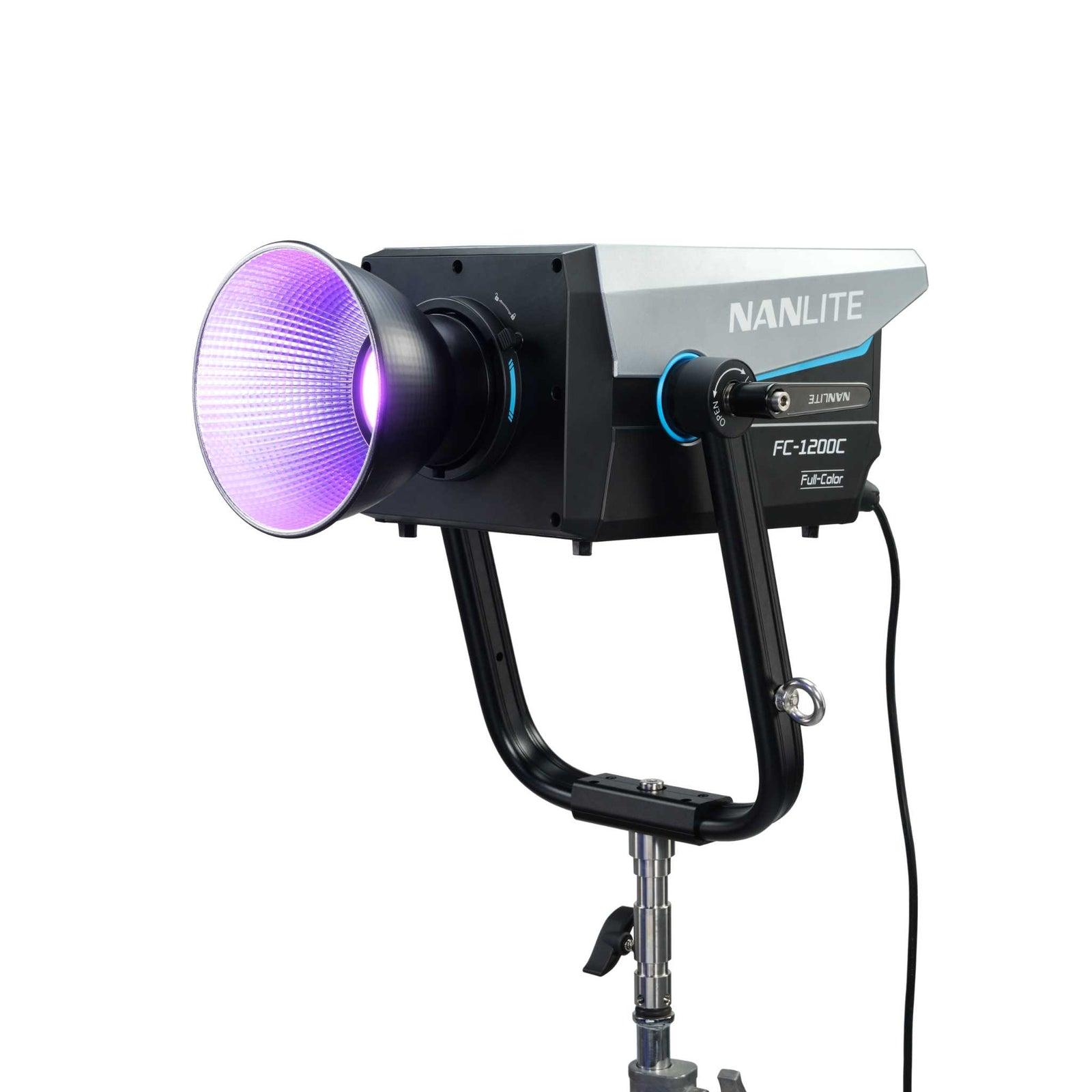
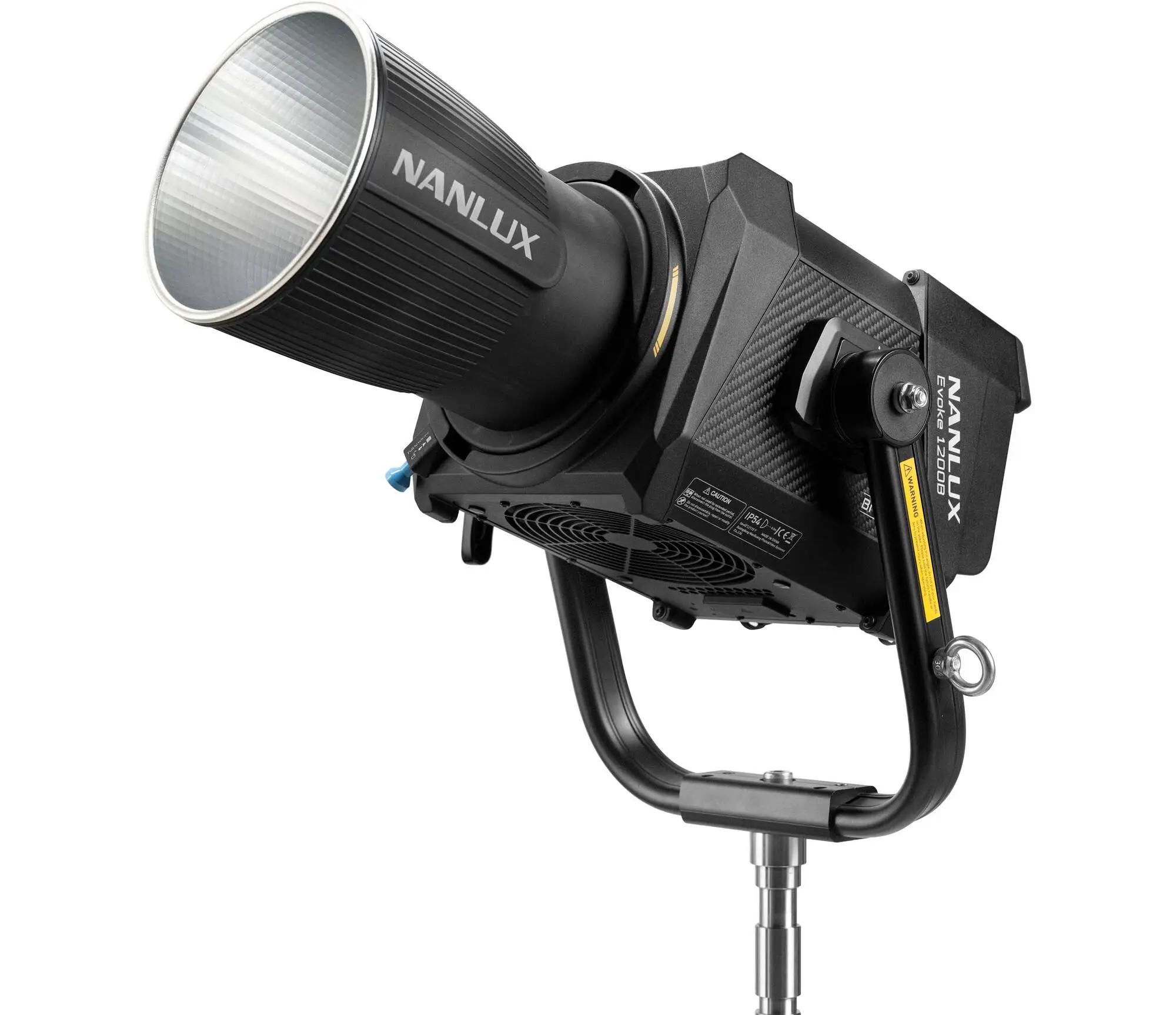
Watts describe a fixture’s electrical power, not how much light reaches the set. According to the data on our product pages, of two lights in the 1,200 W class, the Nanlite FC-1200C gives 14,220 lux at 3 m and the Nanlux Evoke 1200B 18,570 lux under the same conditions (5,600 K, 45° reflector). The manufacturer states a nominal power draw of 1,350 W for the FC-1200C. A specification that only says “at least 1,300 W” would accept the FC-1200C and rule out the Evoke 1200B, whose spec sheet says 1,200 W but which gives more light at the same distance.
One is a full-colour (RGBW) light and the other bi-colour; the wattage does not show that difference either. So write the illuminance you need at your working distance: ask for the distance, colour temperature, reflector or lens and beam angle to be stated, and for the manufacturer’s photometric table to be attached to the offer. Take the required lux value from your lighting plan.
For lights that will be used with a softbox or diffusion, if there is no measurement for that setup, mark the value as unknown and measure it at delivery. Our lux vs watts guide shows with examples how measuring conditions change the result.
Control: DMX, network and wireless
Write the control requirement around the infrastructure in your control room. In broadcast studios, wired DMX512 (5-pin XLR) is usually the baseline; RDM support lets you set address and mode from the console. If you plan network distribution, ask for Art-Net or sACN; for spots where running cable is difficult, ask for wireless CRMX. In a fixed setup with only a few lights, app control can be enough.
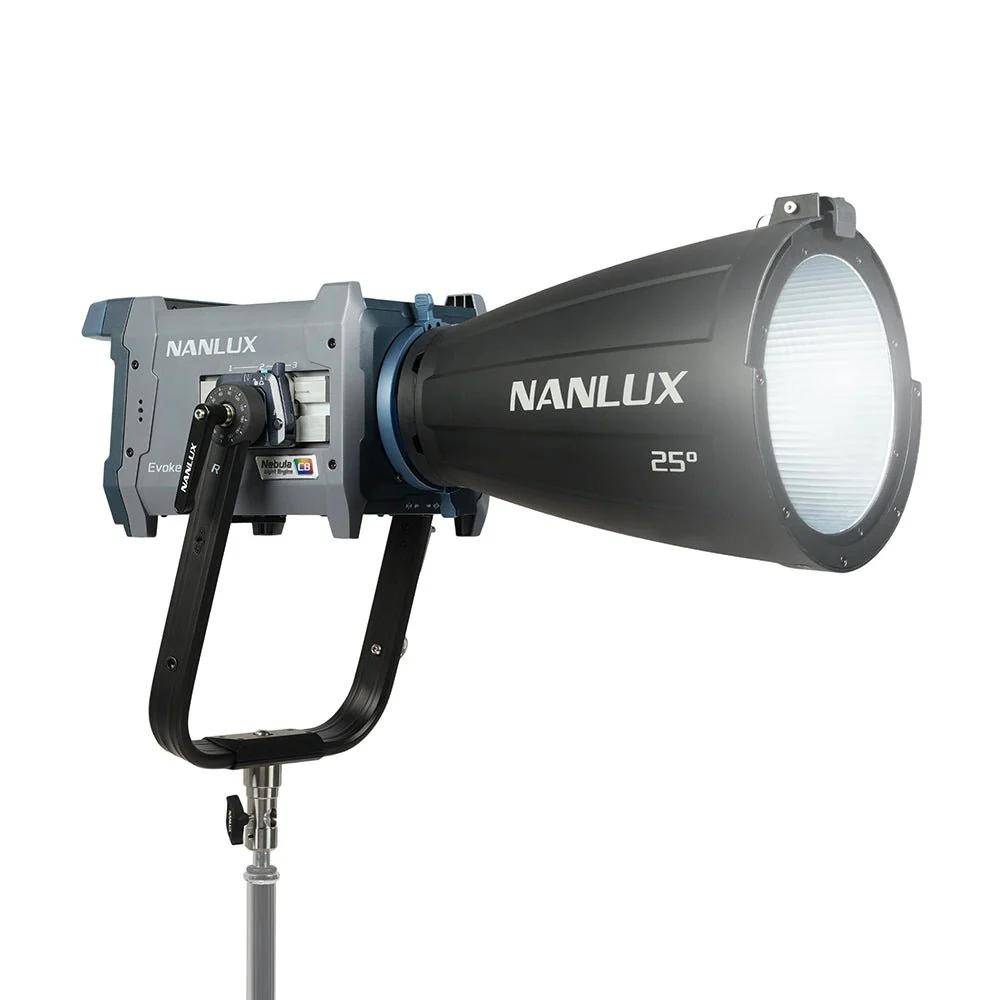
Ask clearly whether the necessary adapters and modules are included in the offer. On some models these features need extra parts: according to our product pages, the Nanlux Evoke 600C has built-in CRMX but needs the extension adapter for DMX/RDM and Art-Net/sACN. Adding the wording “all necessary adapters and modules are included in the offer” to the specification prevents extra items from appearing later.
Also require the DMX channel chart and the address plan at handover. We explain the protocols in detail in our DMX lighting control guide.
Noise, mounting, accessories and power
These criteria sit in the lower rows of a spec sheet, but they directly affect daily use.
Fan noise
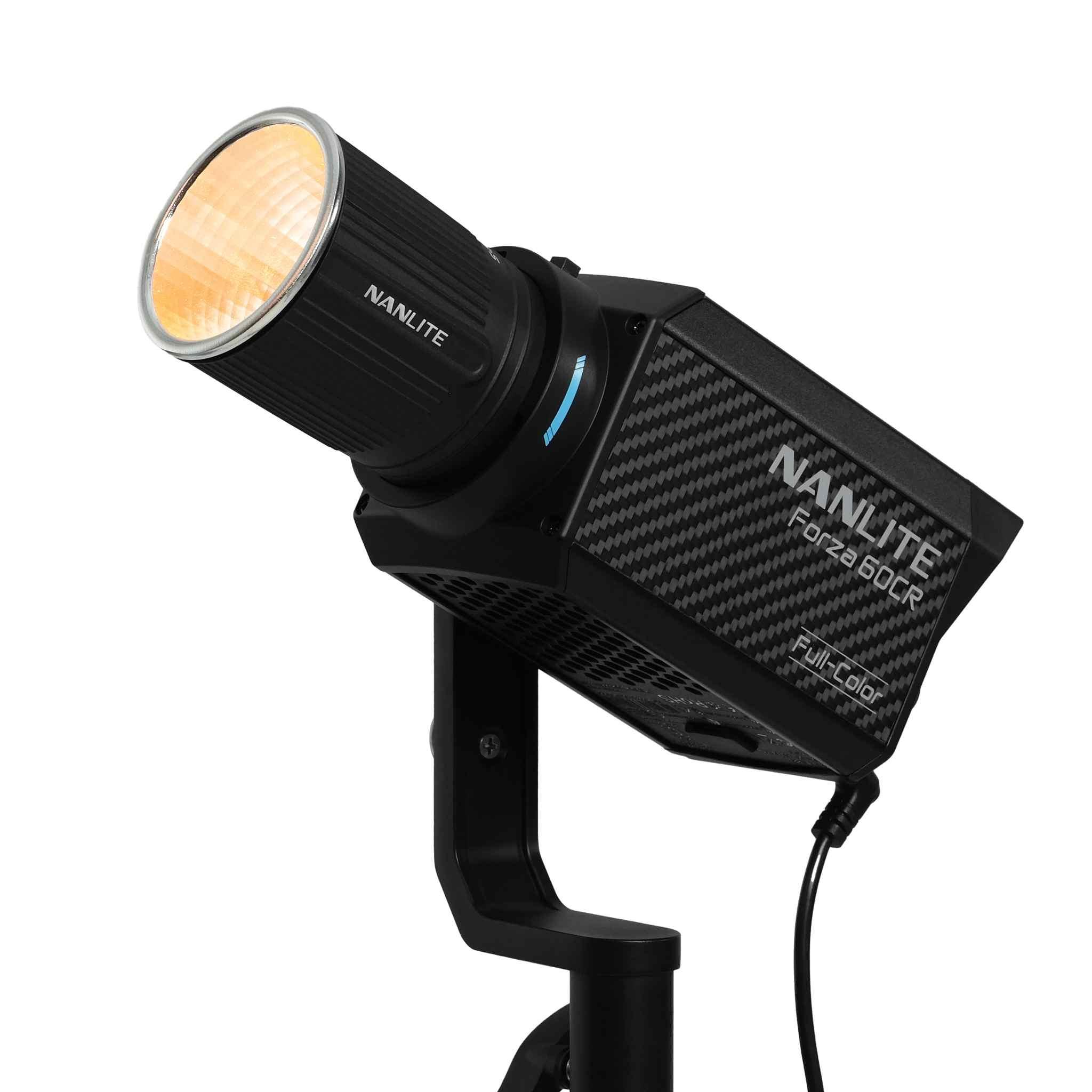
In a studio where you record, fan noise reaches the microphone. Ask for fan noise in dB(A), with the measuring conditions and the fan mode it applies to. Remember that quiet modes can limit output: according to our product pages, the Nanlite Forza 60CR gives at most 50% output with the fan on low and at most 25% with the fan off. Ask whether the light still delivers the illuminance you need in quiet mode.
Weight and mounting
The weight of the head, the yoke and any separate power unit determines the rigging; ask for each one separately. Mounting hardware, clamps and safety cables should be included in the offer. In high-ceilinged studios, pole-operated fixtures, whose direction and focus can be adjusted from the floor with a pole, reduce the need for ladders; specify this separately if you need it.
Accessories
List the accessories to be supplied with each fixture: barndoors, softboxes, grids, diffusers, reflectors or lenses. If you will keep using your existing softboxes and accessories, state the compatible accessory mount (e.g. Bowens). Offers that leave accessories unspecified look similar on paper but do not do the same job.
IP rating
Ask for an IP rating where it is needed. Requiring one for lights used only indoors rules out many models designed for studio use for no reason. If there is outdoor shooting, open-air broadcasting or a risk of rain and dust, make the protection rating a requirement.
Power and cabling
Ask for each fixture’s power draw, input voltage (e.g. AC 100–240 V, 50/60 Hz) and connection type; the total load and circuit plan are based on this information. State the lengths of power and DMX cables, the cable routes and whose scope the power distribution falls under. Electrical work and ceiling rigging must be done by competent people.
Service and support terms
A light is bought once and used for years. Who to call when a fixture fails and how long the repair takes matter as much as the technical figures. In the specification, ask bidders to commit to the following in writing:
- Warranty period and coverage valid in Türkiye
- Authorised service: where and how a faulty unit is sent and, where needed, a document showing authorised dealer or service status
- Spare parts supply and how long parts will be stocked
- Response and repair times after a fault is reported
- Scope of installation, commissioning and DMX addressing
- User training: who receives it and in how many sessions
- Documentation in Turkish: user manual, DMX channel chart and connection diagram
For products bought from True Medya
True Medya is the Türkiye (Turkey) distributor of Nanlite, Nanlux and Pheon Lux and an authorised service for ARRI lighting. Every product bought from True Medya comes with 2 years of full technical support. For repairs, spare parts and usage support, you can open a request on our technical service page.
Acceptance tests at delivery
The figures in a specification only mean something if they are verified at delivery. Write the tests into the specification in advance: which instrument is used, at what distance and settings measurements are taken, and which report the results go into. Different meters can give slightly different readings; measure every light with the same instrument and define the acceptable deviation in the specification.
- Count and check: models, serial numbers and accessories are compared with the offer.
- Colour measurement: colour temperature, CRI and green/magenta deviation are measured with a spectrometer or colour meter, and lights of the same model are checked against each other.
- Illuminance measurement: lux is measured at the distance and settings written in the specification.
- Camera test: flicker is checked at the frame rates and shutter settings in use, including at low brightness.
- Control test: each fixture responds to its DMX address, to RDM and, where used, to network and wireless control, and stored scenes can be recalled.
- Noise test: fan noise is checked in a recording made with the real microphone placement.
- Documentation and training: manuals, channel chart and connection diagram are handed over and user training is completed.
Sample specification table
The wording below is a starting draft. Adapt the values to your use, and fill in the gaps marked with dots from your lighting plan.
| Criterion | Sample specification wording | Why it matters |
|---|---|---|
| Use | The lights will be used for a news desk, interviews and standing presentations in the studio whose dimensions are given in the attached sketch. | Offers are prepared for the same need. |
| Colour accuracy | Average CRI (Ra) must be at least 95 and average TLCI at least 90; the colour temperature at which they are measured must be stated. | Skin tones and set colours look right on camera. |
| Colour temperature | Colour temperature must be adjustable over at least 2,700–6,500 K; the deviation between set and measured values must be declared. | White stays consistent across different lights and cameras. |
| Green/magenta | G/M adjustment must be available, with its range stated in the offer. | Different models and screens can be matched. |
| Flicker | No flicker may be visible on camera at 25 and 50 fps, at the shutter settings in use and across the full dimming range. | Flicker the eye cannot see can show up on camera as banding. |
| Dimming | Must be dimmable from 0 to 100% in fine steps with no visible jumps. | Adjustments made on air go unnoticed on screen. |
| Light output | Must give at least … lux at 3 m and 5,600 K with the stated accessory; the manufacturer’s photometric table must be attached to the offer. | Wattage does not show the illuminance on set. |
| Control | DMX512 (5-pin XLR) and RDM must be supported; all necessary adapters and modules are included in the offer. | The lights work with the control-room console; no extra items come up later. |
| Fan noise | Fan noise must be declared in dB(A), with the measuring conditions and the fan mode it applies to. | Microphones carry fan noise into the recording. |
| Mounting and accessories | Each fixture must be delivered with mounting hardware, a safety cable and the listed accessories. | Offers are compared on the same scope. |
| Service | The warranty period valid in Türkiye, authorised service, spare parts supply and response time to faults must be stated in writing. | It is clear who to call when something fails. |
| Installation and training | Installation, commissioning, DMX addressing and user training are included in the offer; documentation is supplied in Turkish. | The system is ready to use on handover day. |
| Acceptance test | At delivery, colour and illuminance measurements, a camera test and a control test are carried out; the results are recorded in a report. | The figures in the specification are verified on site. |
Common mistakes
- Describing the lights by wattage alone.
- Not asking for photometric data, or asking for lux without distance, colour temperature and accessory.
- Copying one product’s spec sheet into the specification as it is.
- Not asking about fan noise and how much output drops in quiet mode.
- Leaving adapters, modules, mounting hardware and accessories out of scope.
- Leaving out warranty, authorised service and spare parts clauses.
- Signing the acceptance report without measurements and a camera test.
Frequently asked questions
Can we name a brand and model in the specification?
In public procurement, a specification is expected not to point to a single brand; where a model is named as a reference, “or equivalent” is usually added. Check the practice in your organisation with your procurement and legal teams. Measurable performance criteria instead of brand names also make offers easier to compare.
What CRI and TLCI values should we ask for?
In broadcast studios, 95 or above for CRI and 90 or above for TLCI are commonly used thresholds; lights with a TLCI above 90 usually need no colour correction. State whether the value is an average or a minimum and at which colour temperature it is measured, and measure under the same conditions at delivery.
How should we compare the offers we receive?
Fill in the same table for every offer: criterion, required value, offered value and the source of that value (spec sheet, photometric data or test). Mark missing information as unknown and ask the bidder to complete it.
What instrument do we need for measurements at delivery?
Use a spectrometer or colour meter that measures colour temperature, illuminance and colour values such as CRI. If you also want to see TLCI, make sure the instrument can calculate it. Measure every light with the same instrument at the same distance and settings.