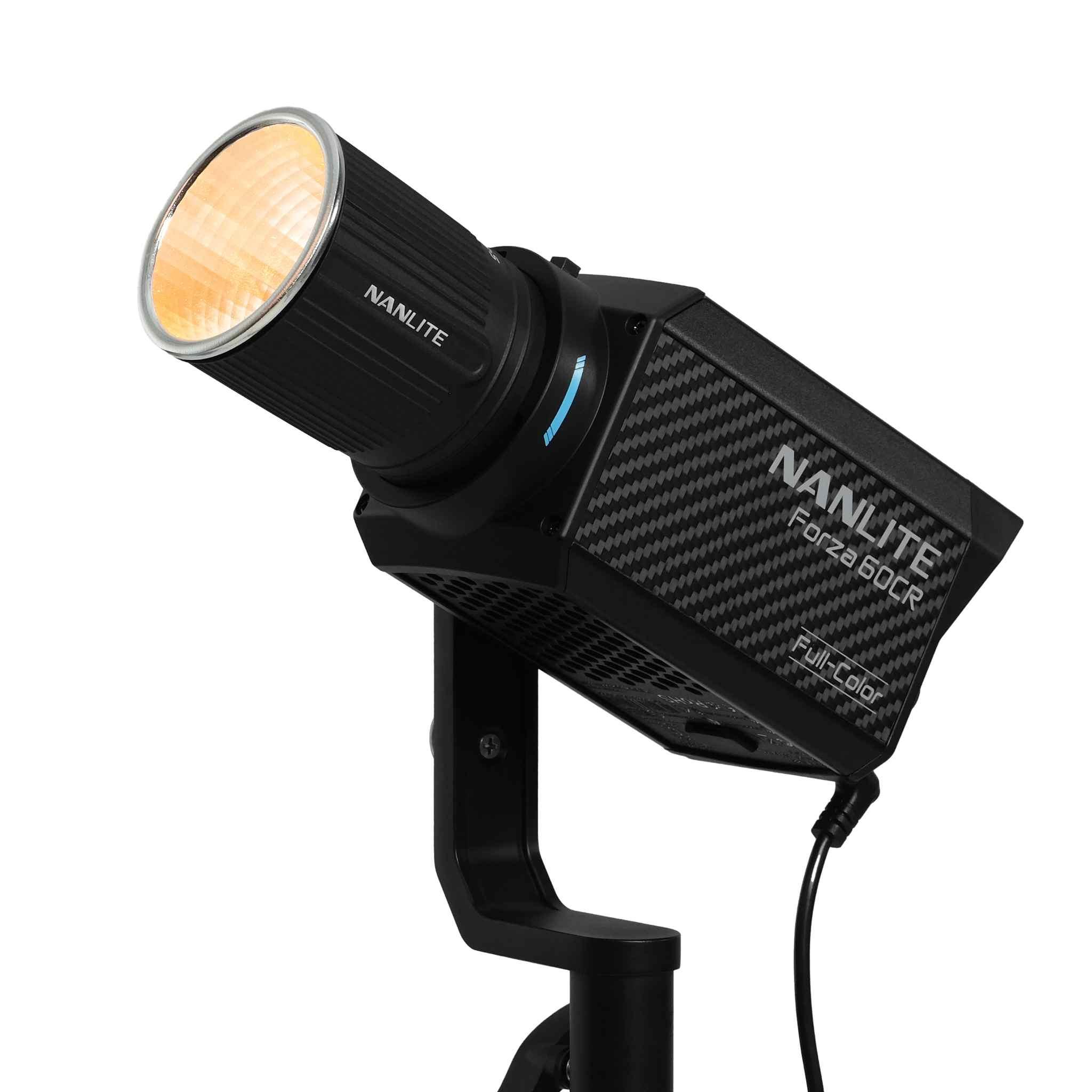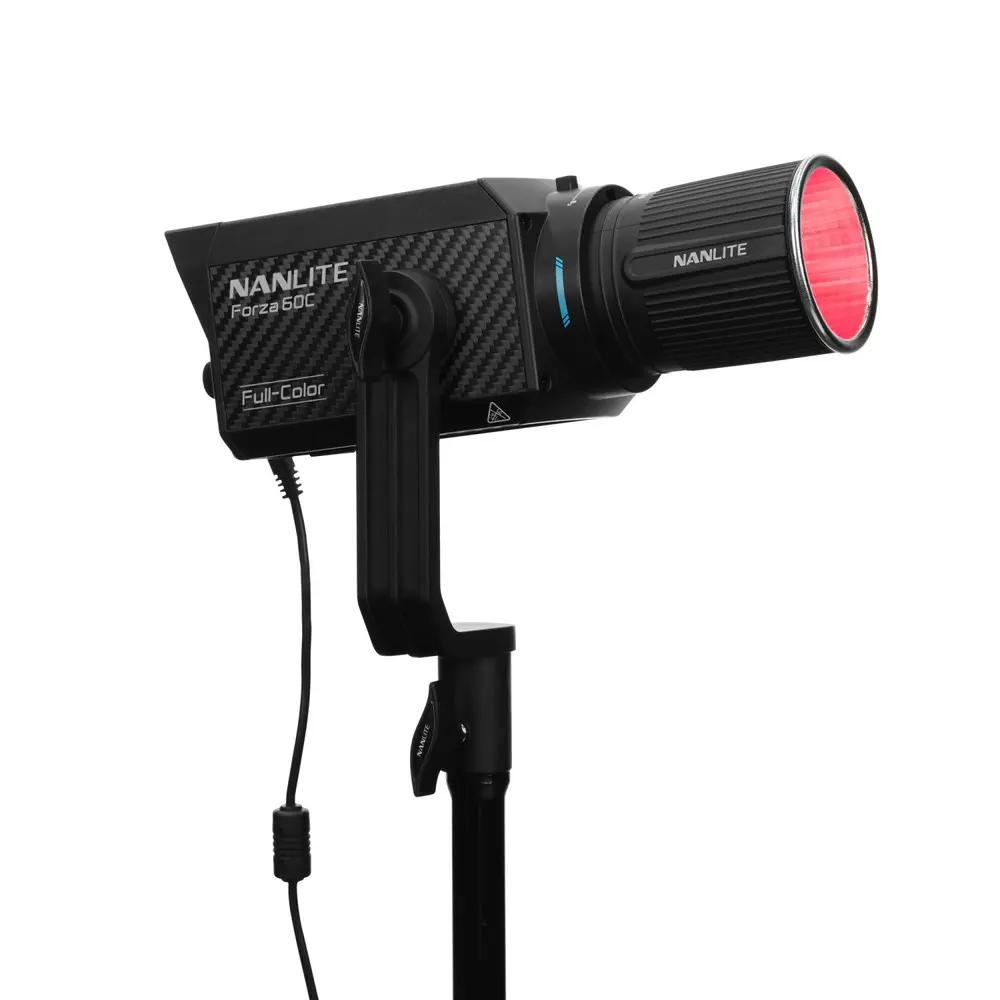
The short answer
- If you will run the lights on the fixture, by remote, with the NANLINK app or over wired DMX, the Forza 60C is enough.
- If you will run them on set from a DMX console with a CRMX transmitter and no cables, the Forza 60CR removes the need for a separate receiver and cable.
- If you already own a 60C, you do not need a new light for CRMX: according to Nanlite, the 60C can be converted to a 60CR with a paid hardware upgrade at authorised service centres.
Technical comparison
| Specification | Forza 60C | Forza 60CR |
|---|---|---|
| Rated power | 88 W | 88 W |
| Light engine | RGBLAC (six colours) | RGBLAC (six colours) |
| Colour temperature | 1,800–20,000 K | 1,800–20,000 K |
| Green/magenta | ±100 | ±100 |
| CRI / TLCI (average) | 96 / 95 | 96 / 95 |
| TM-30 Rf / Rg (average) | 93 / 100 | 93 / 100 |
| Illuminance (1 m, 5,600 K, reflector) | 12,810 lux | 12,810 lux |
| Colour modes | CCT, HSI, RGBW, XY coordinates; 15 effects | CCT, HSI, RGBW, XY coordinates; 15 effects |
| Control | On-board, remote, NANLINK app, DMX/RDM | On-board, remote, NANLINK app, DMX/RDM, LumenRadio CRMX |
| Built-in wireless DMX receiver | No | LumenRadio CRMX |
| Fan | Smart fan; about 22 dB(A) at low speed and 35 °C ambient; can be switched off | Smart, full speed, low speed and off modes |
| Maximum output by fan mode | 25% with the fan off | 100% in smart and full speed, 50% at low speed, 25% off |
| Power input | DC 15 V (6 A max); AC 100–240 V via adapter | DC 15 V (6 A max); AC 100–240 V via adapter |
| Lamp head weight | 1.08 kg | 1.16 kg |
| Lamp head size (without COB cap) | 224 × 110 × 88 mm | 224 × 110 × 88 mm |
| Accessory mount | FM mount; Bowens adapter included | FM mount; Bowens adapter included |
What does LumenRadio CRMX add?
LumenRadio CRMX carries the DMX signal wirelessly: a transmitter on the console sends it and the receiver in the light reads it like wired DMX. On the Forza 60CR the receiver is built in, so there is no separate receiver box on the stand and no DMX cable to run to the light. According to Nanlite, this lets the 60CR be controlled wirelessly together with the other fixtures on set.
The Forza 60C also supports DMX/RDM, but wireless use needs an external receiver. Nanlite states that the USB port on the lamp head can power a wireless DMX receiver. For channels, addresses and wireless links, see our DMX lighting control guide.
Power, batteries and accessories
Both models run from mains through the included 15 V / 6 A power adapter or from the NP-F battery grip, also in the box, which helps for handheld shots and locations without power. According to Nanlite, both run for about two hours at 100% brightness on a 14.8 V 160 Wh battery.
The accessory mount is the FM mount; with the included Bowens adapter, Bowens-mount softboxes and attachments fit too. The box also holds the RF-FMM-45-S reflector, a COB protective cap, a 3 m power cable and a carrying bag. The separately sold FL-11 Fresnel lens gives 37,520 lux at 1 m and 5,600 K in its 10° spot position.
Which one for which job?
| Use | Pick | Why |
|---|---|---|
| Single-light YouTube or interview shoot | Forza 60C | On-board and app control are enough; same light quality |
| Handheld or battery-powered location shoot | Either | Both ship with the NP-F battery grip |
| Studio with wired DMX infrastructure | Forza 60C | Both models have DMX/RDM |
| Set run from a console with a CRMX transmitter | Forza 60CR | Built-in receiver; no separate box or cable |
| Moving your existing 60Cs to wireless DMX | 60C to 60CR upgrade | Paid hardware upgrade at an authorised service centre |
Frequently asked questions
What is the difference between the Forza 60C and Forza 60CR?
The 60CR has a built-in LumenRadio CRMX wireless DMX receiver; the 60C does not. Power (88 W), the RGBLAC light engine, the 1,800–20,000 K colour temperature range and output are the same; the 60CR lamp head is 80 g heavier at 1.16 kg.
Can a Forza 60C be upgraded to a 60CR?
Yes. According to Nanlite, the 60C can be converted to a 60CR with a paid hardware upgrade at authorised service centres. Ask the place of purchase for details.
Can the Forza 60C be used with wireless DMX?
Yes, with an external wireless DMX receiver. The USB port on the lamp head can power such a receiver. On the 60CR the LumenRadio CRMX receiver is built in.
Do both models take the same accessories?
Yes. Both have the FM mount and ship with a Bowens adapter for Bowens-mount accessories, so the reflector, Fresnel lens, projection attachment and softbox options are shared.
How long do the Forza 60C and 60CR run on a battery?
According to Nanlite, both run for about two hours at 100% brightness on a 14.8 V 160 Wh battery. Both ship with the NP-F battery grip.