The short answer
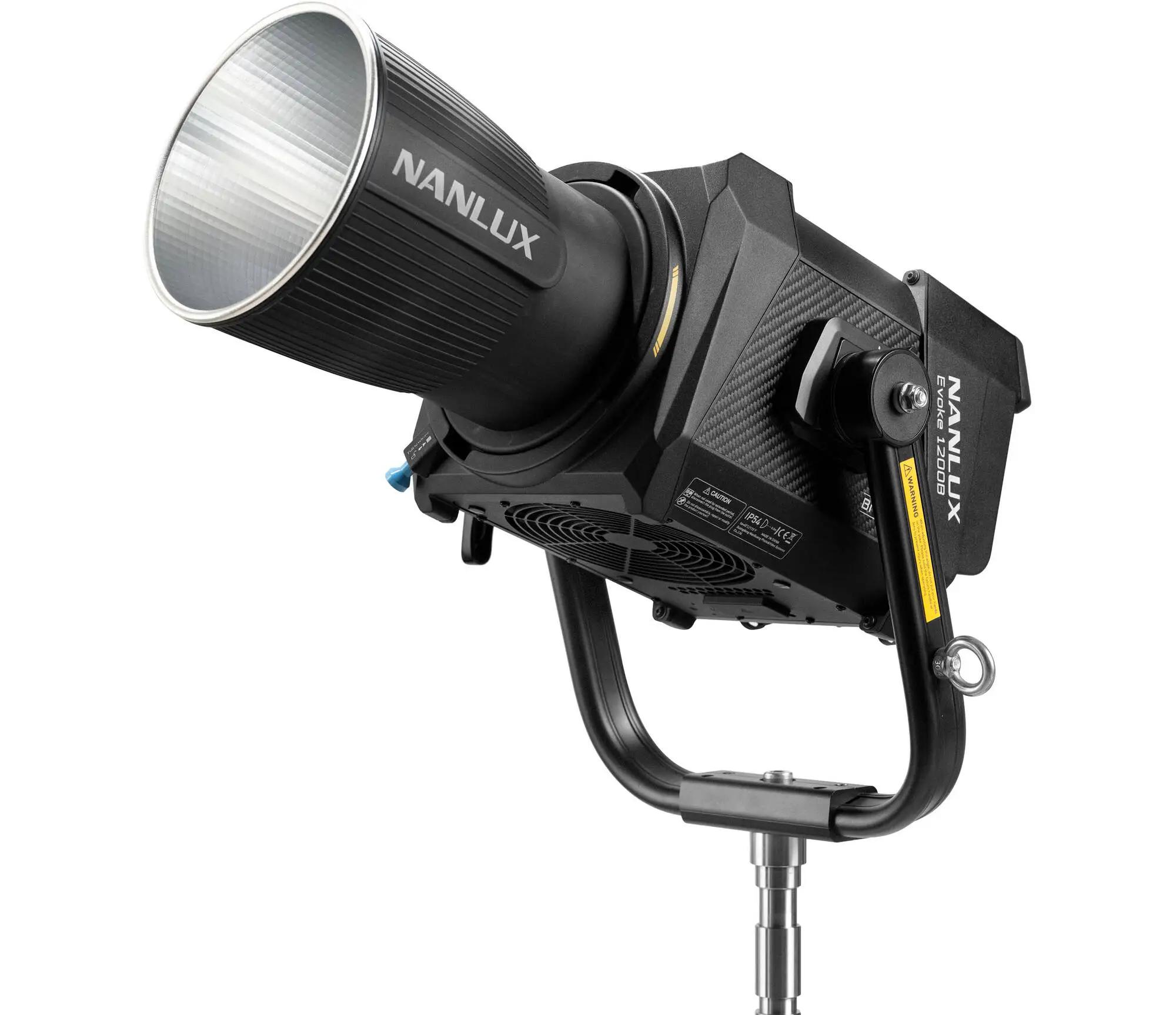
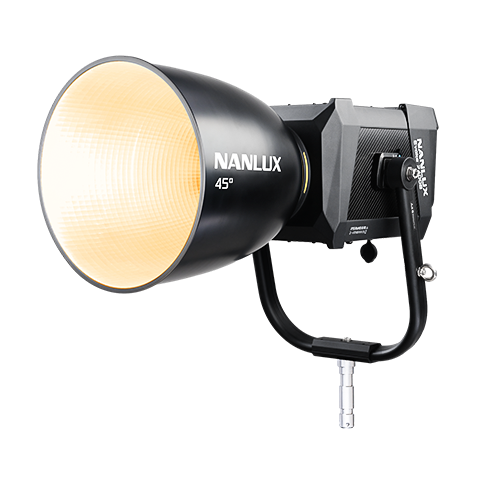
- Evoke 1200B: with a 7.75 kg head and a separate power supply, the lightest and easiest of the three to move. A sensible starting point for mid-sized TV and corporate studios, commercials and location shoots.
- Evoke 2400B: roughly twice the 1200B’s illuminance under the same measuring conditions, ±80 green/magenta adjustment, Art-Net/sACN and IP55. For large studios, stages and setups where the light sits far away.
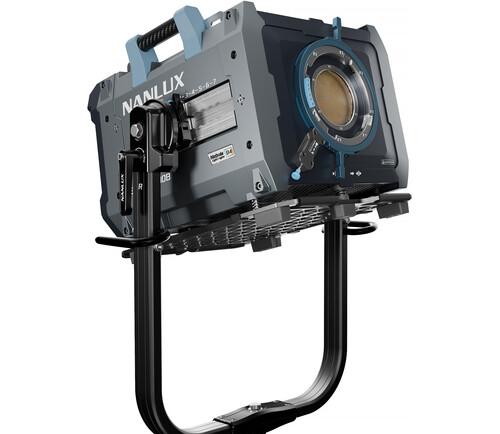
- Evoke 5000B: lamp head, control unit and power supply in one body, IP66 and a 95° beam angle. For very large sets, night and rain exteriors and sunlight effects over a wide area.
Technical comparison
| Specification | Evoke 1200B | Evoke 2400B | Evoke 5000B |
|---|---|---|---|
| Rated power | 1,200 W | 2,400 W | 5,000 W (200–240 V); 5,200 W (100–125 V) |
| Colour temperature | 2,700–6,500 K | 2,700–6,500 K | 2,700–6,500 K |
| Green/magenta | — | ±80 | ±80 |
| CRI / TLCI (average) | 96 / 97 | 96 / 97 | 97 / 98 |
| TM-30 Rf / Rg (average) | 95 / 102 | 95 / 100 | 96 / 102 |
| Beam angle | — | — | 95° |
| Headline measurement (5,600 K) | 18,570 lux (3 m, 45° reflector) | 41,910 lux (3 m, 45° reflector) | 57,000 lux (5 m, 30° reflector) |
| Dimming | 0–100%, 0.1% steps | 0–100%, 0.1% steps | 0.0–100.0%, 0.1% steps |
| IP rating | IP54 (head and power supply) | IP55 (head and power supply) | IP66 |
| Body | Lamp head + separate power supply | Lamp head + separate power supply | Lamp head, control unit and power supply in one body |
| Power input | AC 100–240 V, 50/60 Hz; DC 48 V, 25 A max | AC 100–240 V, 50/60 Hz, 26 A max; DC 48 V, 26 A × 2 | AC 100–240 V, 50/60 Hz, 52 A max |
| Weight | Head 7.75 kg; yoke 1.84 kg; power supply 10.5 kg | Head 15 kg; power supply 11.58 kg | Fixture about 41 kg; yoke about 3 kg |
| Control | On-board, remote, NANLINK, DMX/RDM, LumenRadio CRMX | On-board, wired controller, remote, NANLINK, DMX/RDM, LumenRadio CRMX, Art-Net/sACN | On-board, wired controller, remote, NANLINK, DMX/RDM, LumenRadio CRMX, Art-Net/sACN, NFC |
| Fan noise (smart mode) | — | About 29 dBA | 44 dB(A) |
| Maximum output with fan off | 10% | 15% | — |
| Accessory mount | NL mount | NL mount (electronic contacts) | NL mount (PosiTight lock) |
Illuminance by distance
The fairest way to compare the three is the manufacturer’s measurements at 5,600 K with a 45° reflector. At 5 m the 2400B gives roughly twice the illuminance of the 1200B, and the 5000B roughly 1.7 times that of the 2400B. The 1200B’s measurements go up to 9 m (2,547 lux); the 2400B and 5000B tables cover 10 m and beyond.
The manufacturer also compares output with traditional sources: more than a 1.8K HMI PAR or a 2.5K Fresnel for the 1200B, more than a 4 kW HMI or a 10 kW tungsten for the 2400B, and approaching a 9 kW HMI or a 24 kW tungsten for the 5000B. These are reflector measurements; with a softbox or diffusion the illuminance drops. Our lux and watts guide explains how to read these tables.
| Distance | Evoke 1200B | Evoke 2400B | Evoke 5000B |
|---|---|---|---|
| 3 m | 18,570 lux | 41,910 lux | — |
| 5 m | 6,800 lux | 14,070 lux | 24,020 lux |
| 7 m | 3,872 lux | 7,254 lux | — |
| 10 m | — | 3,607 lux | 6,220 lux |
Weight, body and rigging
The 1200B’s head weighs 7.75 kg and its yoke 1.84 kg. The 10.5 kg power supply sits separately and connects with the standard 7.5 m DC cable; the manufacturer offers 10 m and 12 m cables as options. A quick-release clamp secures the power supply to a stand or truss, and the 15° offset yoke gives a wider tilt range with a softbox fitted. That weight makes stand or grid mounting straightforward in mid-sized studios.
The 2400B’s head weighs 15 kg and its power supply 11.58 kg. The manufacturer says the magnesium-alloy body makes the head lighter than other lights with the same power output; even so, it needs heavy-duty stands and rigging points planned for the load. Nanlux also offers the YK-E-EVL motorised yoke for the 2400B and 5000B, with 540° pan and 270° tilt, which is useful for aiming a fixture rigged high from the floor.
On the 5000B the lamp head, control unit and power supply share one body: there is no separate power supply and the fixture runs on a single cable. In return the fixture weighs about 41 kg and the yoke about 3 kg. The disc-brake yoke with angle indicator, the balance rails and the spring-mounted skid make positioning and transport easier. For a light in this class, check the load rating of stands and rigging points before installation, and leave rigging to qualified people.
Power and mains
The 1200B and 2400B run on AC 100–240 V mains and on DC 48 V; the 2400B’s technical data lists two DC inputs (26 A × 2) and up to 26 A on the AC side. The 5000B’s official technical data lists AC input only: 100–240 V, 52 A max. Rated power is 5,000 W in 200–240 V regions and 5,200 W in 100–125 V regions.
Do not plan 2,400 W and 5,000 W fixtures around an ordinary socket circuit shared with other equipment. Total studio load, circuit capacity and connection type should be settled with a qualified electrician before installation. On stages that will use several 2400B or 5000B units, this is the first item of the site survey.
Exteriors and weather
All three come with weather-resistant housings, but at different protection levels. The 1200B’s head and power supply are rated IP54, the 2400B’s IP55. According to the manufacturer, the 5000B’s IP66 magnesium-alloy housing is built to keep shooting through harsh weather.
For shooting in the rain, the manufacturer asks that unused ports on the control panel be covered with their waterproof caps. On long outdoor setups, plan cable connections and power distribution with the same care.
According to the manufacturer, the 5000B’s 95° beam angle suits lighting large areas without a modifier, with light quality and shadows that closely mimic sunlight. Natural-light simulation and lighting wide areas are where it stands out. The manufacturer also says its High Speed mode, which switches from PWM to DC, keeps high-frame-rate shots flicker-free.
Control and studio integration
All three have a 5-pin XLR DMX/RDM connection and a built-in LumenRadio CRMX (TimoTwo) module, so they can be connected to a lighting console both by cable and wirelessly. The 2400B and 5000B also support Art-Net/sACN through two LAN ports. In large studios that need many universes and long cable runs, that difference matters.
The 5000B ships with the IP66 WC-EXT wired controller on an 8 m cable, so settings can be changed from the floor when the fixture is rigged high. The 2400B’s head also has a wired-control socket. According to the manufacturer, the WC-LM6P-C1 wired controller works with the 1200B, 2400B and 5000B. For DMX address plans and wireless control, see our DMX lighting control guide.
Accessories and light shaping
All three use Nanlux’s NL mount. For the 1200B, RF-NLM series 26°, 45° and 60° reflectors and Fresnel lens measurements are published. The 2400B and 5000B share the RF-NL-L series reflectors, the NL70 parallel beam reflector (RF-NL-PB) and NL mount softboxes; according to the manufacturer, the 5000B is compatible with most 2400B accessories.
Take care when choosing a Fresnel: according to the manufacturer, the FL-28 Fresnel lens runs at full output on the 1200B and at 50% output on the 2400B. Measurements with the FL-35E motorised Fresnel (15°–46°) are also published for the 2400B. The FL-45E motorised Fresnel developed for the 5000B zooms from 16° to 50° and gives 79,500 lux at 5 m, 5,600 K, at 16°; when the FL-35E or the PJ-NLM-15-30 projection attachment is fitted to the 5000B, the fixture’s output is limited automatically.
Which one for which job?
| Use | Pick | Why |
|---|---|---|
| Mid-sized TV and corporate studio | Evoke 1200B | Light head, DMX/RDM and CRMX; key light through a softbox or diffusion |
| Commercials, music videos and location shoots | Evoke 1200B | Easy to move; DC 48 V input; IP54 |
| Large studio or stage, long throw | Evoke 2400B | About twice the 1200B’s illuminance at 5 m; Art-Net/sACN |
| Matching other sources with green/magenta | Evoke 2400B or 5000B | ±80 green/magenta adjustment |
| Night and rain exteriors | Evoke 5000B | IP66; one body, one cable |
| Sunlight effect over a wide area | Evoke 5000B | 95° beam angle, the highest output of the three |
When is the 1200B enough?
Small and mid-sized studios usually need well-placed, softened light rather than the most powerful fixture. According to the manufacturer’s measurements, the 1200B gives 18,570 lux at 3 m with a 45° reflector; in a studio that output is usually softened with a softbox or diffusion. Unless the light has to sit 10 m or more away, work through a large diffusion frame or balance strong daylight, the 1200B is enough for most jobs.
Several models can also share one project: for example the 1200B for close-in lights and the 2400B for a back or background light from far away. We used Nanlux and Nanlite lights together in Diyanet TV’s main studio in Ankara. For studio projects see our TV and news studio installation page, and for full-colour models our Evoke 600C vs 900C comparison.
Frequently asked questions
What is the main difference between the Evoke 1200B and 2400B?
Output and weight. According to the manufacturer, at 5 m, 5,600 K with a 45° reflector the 2400B gives 14,070 lux and the 1200B 6,800 lux; in return the 2400B’s head weighs 15 kg against the 1200B’s 7.75 kg. The 2400B also adds ±80 green/magenta adjustment, Art-Net/sACN and IP55.
Does the Evoke 5000B have a separate power supply?
No. On the 5000B the lamp head, control unit and power supply share one body, and the fixture runs on a single cable. The official technical data lists AC 100–240 V, 52 A max as input. The 1200B and 2400B come with a separate power supply.
Which one can be used in the rain?
The 5000B has the highest protection: IP66. The 2400B is rated IP55 and the 1200B IP54, and on both the power supply has the same rating. For shooting in the rain, the manufacturer asks that unused ports be covered with their waterproof caps.
Do all three use the same accessories?
Partly. All three use the NL mount, and according to the manufacturer the 5000B is compatible with most 2400B accessories. Reflectors differ: RF-NLM series for the 1200B, RF-NL-L series for the 2400B and 5000B. Some Fresnel and projection attachments limit output on the larger models.
Can they be controlled over DMX?
Yes. All three have 5-pin XLR DMX/RDM and built-in LumenRadio CRMX. The 2400B and 5000B also support Art-Net/sACN through their LAN ports.